You know what your team produces. Do you know who they are?
\"Work on your relationships\" is some of the least useful feedback a leader can get. Trust isn't a personality trait. It's a set of behaviors, and the first one is knowing the people you lead as more than their job.
Picture an engineer whose work is excellent and whose ideas keep losing. Less rigorous proposals get funded in the same meetings where his get turned down. Eventually someone gives him the feedback: you need to work on your relationships.
He finds it maddening, and honestly, it's not much to go on. He has relationships. He goes to the meetings. He answers the messages. He's on time.
Then one evening he tries a small test. He thinks through each person he works with most and asks what he actually knows about them. He can name their titles and what they deliver. He can't name what they care about outside work, what they want next, or what's going on at home. He knows what they produce. He doesn't know who they are.
That's uncomfortable. It's also the most useful thing he's learned in months.
Trust is something you do
Nobody trusts you because you told them to. James Hunter makes the point in The Servant that the qualities we associate with good leaders, like patience, honesty and respect, aren't feelings. They're behaviors. You can choose them on a day you don't feel like it.
Trust works the same way. It isn't declared. It builds up from what people watch you do, over and over, mostly when nothing much is at stake. The useful question isn't whether you intend to be trustworthy. It's whether your last 30 days would convince someone you are.
The FORD check
There's a simple way to see where you stand. FORD is a common rapport framework: Family, Occupation, Recreation, Dreams. It's a decent map of where people's real priorities live.
Try it on your own team. For each person who reports to you, how many of the four could you fill in from memory?
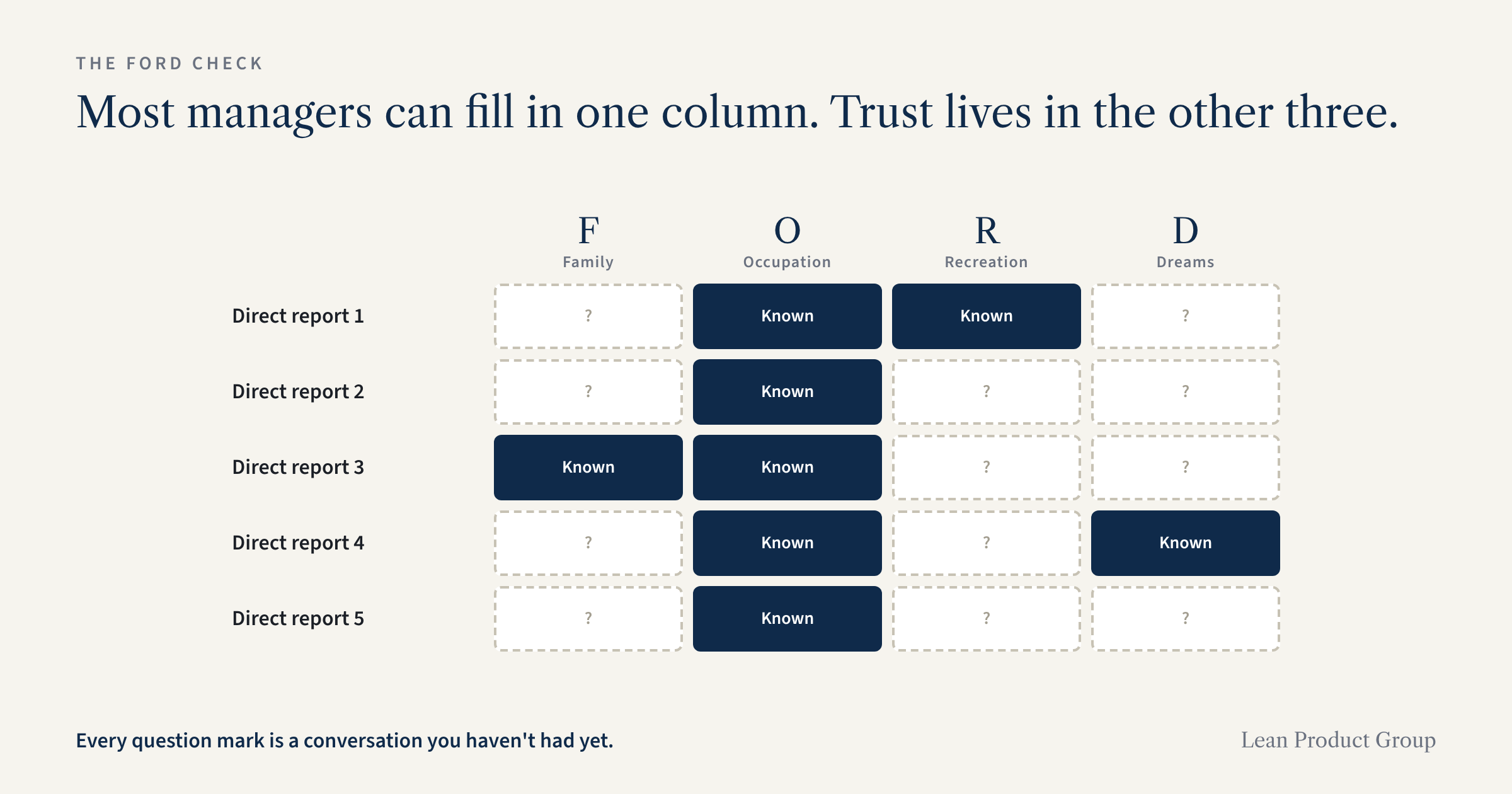
If your grid looks like this one, you're normal. Most managers know the Occupation column cold, because that's what the 1:1s are about. The other three are mostly blank.
That matters more than it seems. When a deadline slips or a reorg lands or you need someone to give more than the job requires, the relationship you've built is what you draw on. If all you know is what someone produces, there isn't much there to draw on.
Likeability is a skill, not a gift
Jack Schafer spent his career at the FBI studying why people trust and open up to strangers. What he found in The Like Switch is that likeability isn't charisma. It's a handful of signals anyone can send on purpose: being present, paying real attention, remembering the details, asking the follow-up question.
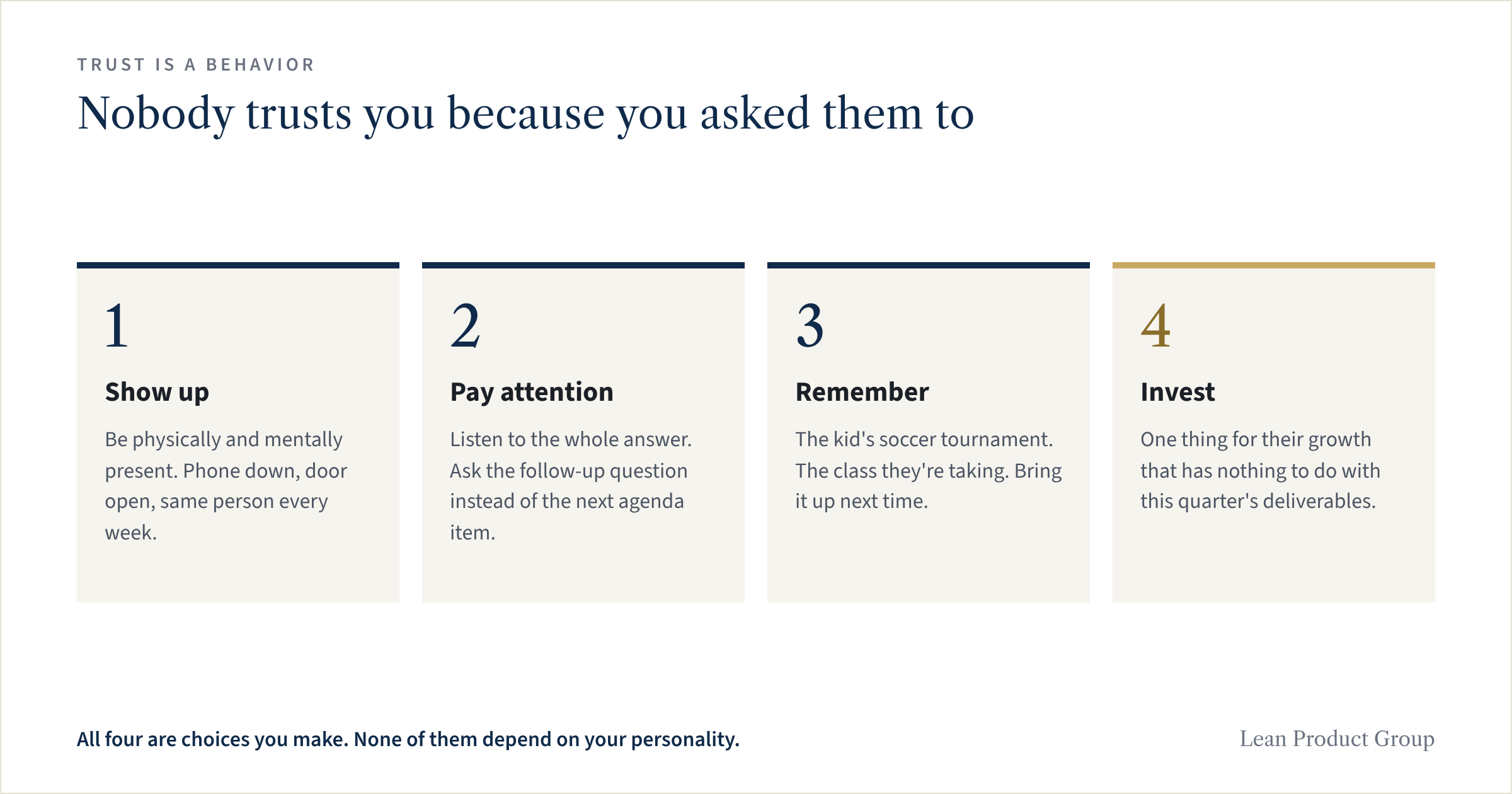
Some leaders wave this off as soft. I'd push back on that. People give discretionary effort to leaders they like and trust. That isn't vanity. It shows up in how hard people work when you're not watching.
The best leaders grow other leaders
Noel Tichy studied high-performing organizations and found one pattern again and again: the best leaders deliberately develop the people around them. Not just their performance this quarter, but where they're headed.
That's the fourth card above, and it's the one most of us skip. Knowing someone's Dreams column isn't small talk. It's what lets you actually help them get there, and very little builds trust faster than a manager who clearly sees you as someone with a future, not just a resource on this year's plan.
Try one conversation
Pick the person on your team whose FORD row has the most question marks. Get coffee or take a walk, anything that isn't a 1:1 in a conference room. Go in curious, not with a checklist. If you spend the whole time on what they do on weekends, that's fine. That's a real conversation.
Afterward, write down one thing that surprised you.
The rest of the module
This is the fourth module of The Servant Leader, our leadership curriculum at Lean Product Group. The full module includes a complete FORD audit for your whole team, a 30-day plan for your lowest-trust relationship, a guided conversation with prepared questions, and a coaching prompt to pressure-test whether your plan will feel genuine or performative.
The course is free. Sign in with your email and it's yours.