Eight ways a bank can get into merchant acquiring, and what AI agents change
Banks that want a piece of merchant acquiring have more options than "build a processor" or "stay out." The real decision is how much of the merchant you want to own. AI agents are starting to change what each option asks of a bank.
When a bank tells me it wants to "get into payments," the conversation usually jumps straight to the biggest version of the idea. Become a sponsor bank. Build a PayFac. Maybe buy a processor.
Those are real options. They're also the slowest, riskiest and most expensive ones, and most banks don't need to start there. There are eight ways a bank can offer merchant acquiring, and they line up along one question: how much of the merchant do you want to own?
Four ways in
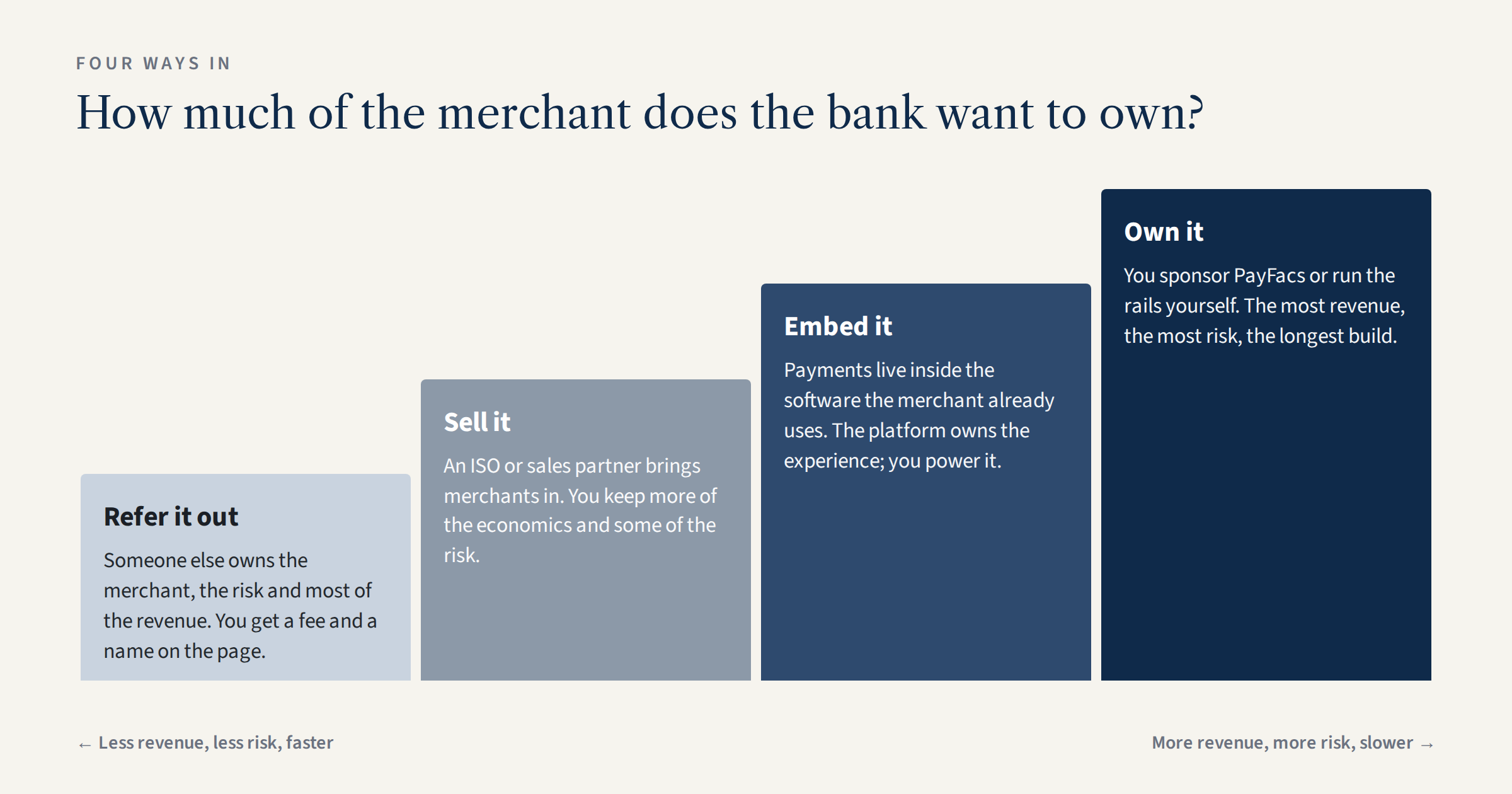
Refer it out. The bank pays or earns a referral fee and someone else does the work. It's live in weeks and carries almost no risk. It also earns almost nothing, and the merchant never really feels like your customer.
Sell it. An ISO brings merchants in. A retail ISO sells under a processor's pricing for a commission. A wholesale ISO takes on more of the risk and keeps more of the economics. This is the traditional route, and it puts the bank head to head with Square and Stripe for small merchants.
Embed it. The bank works with software platforms, the integrated software vendors (ISVs), so payments happen inside the software a business already runs on. The platform owns the experience. The bank powers it. This is where a lot of new volume is going.
Own it. The bank becomes a sponsor for payment facilitators, or helps a platform become one. The platform can rent the PayFac infrastructure or build its own. At the far end, the bank runs processing itself.
The tradeoff, in numbers
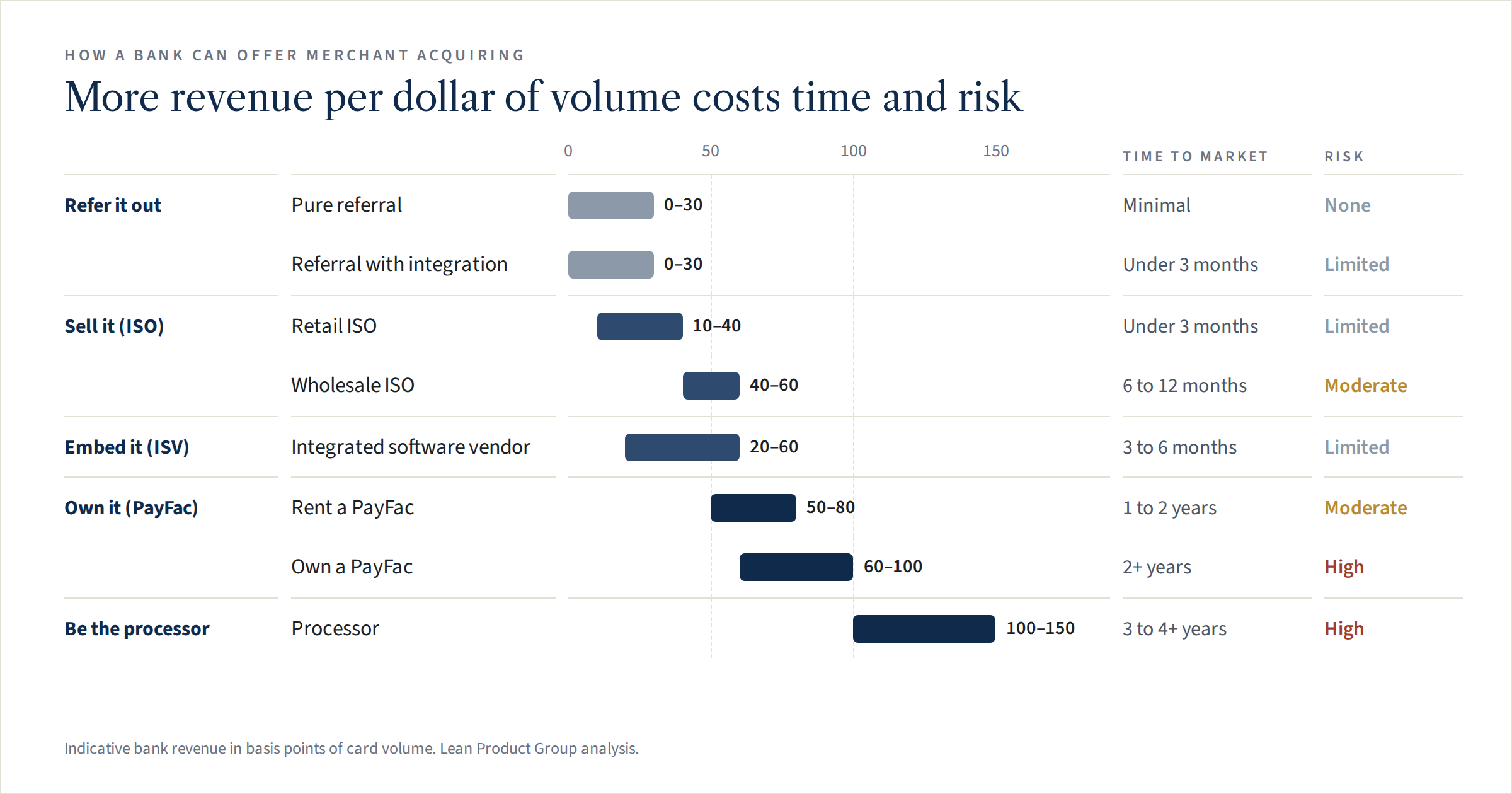
Read across and the pattern is plain. Every step to the right earns more per dollar of volume and asks for more: more time, more operating cost, more risk the bank carries on its own books.
Two things stand out to me.
First, the ISV row. It gets close to wholesale ISO economics with limited risk and a time to market in months, not years. For most banks it's the best first serious move, and it's the one most often skipped on the way to "let's sponsor PayFacs."
Second, the jump from renting a PayFac to owning one. The revenue range moves up a little. The build moves from one or two years to two years or more, and the risk goes from moderate to high. That's a big step for a modest gain, and banks should make it on purpose, not by drift.
What the bank actually has to build
Whatever the model, the same handful of capabilities have to exist somewhere: onboarding and underwriting, transaction capture through a gateway, reporting for partners and merchants, and billing and settlement. Split payments, pricing management and terminal management come along later.
The question at each step is who provides them. In a referral, nobody at the bank does. In an ISV model, the bank needs onboarding, risk and reporting that a platform can plug into through APIs. To sponsor PayFacs, the bank has to underwrite the platforms themselves and watch their whole portfolio.
That's why the smart path is a progression, not a leap. Start where the capabilities you have are enough. Build the next set while the first model earns. Platforms move the same way: a software company might start as a referral partner, grow into an integrated partner, and later want to rent, then own, its PayFac. The bank that can move with them keeps the relationship.
Where AI changes the math
This is the part I find most interesting right now, because AI is changing two things at once.
It changes who's shopping. Visa launched Intelligent Commerce Connect in April 2026 as a single integration for payments started by AI agents, covering the main agent protocols. Agents will carry tokens tied to a specific purchase, backed by strong authentication. A Visa product leader for agentic commerce told PYMNTS this month that the industry still hasn't worked out what an agent identity is, and that no merchant is going to rip out its payment stack to make agents work.
That lands on the acquirer. Someone has to tell a legitimate shopping agent from a bot, decide who carries the loss when an agent buys the wrong thing, and score fraud on traffic that doesn't look like a person.
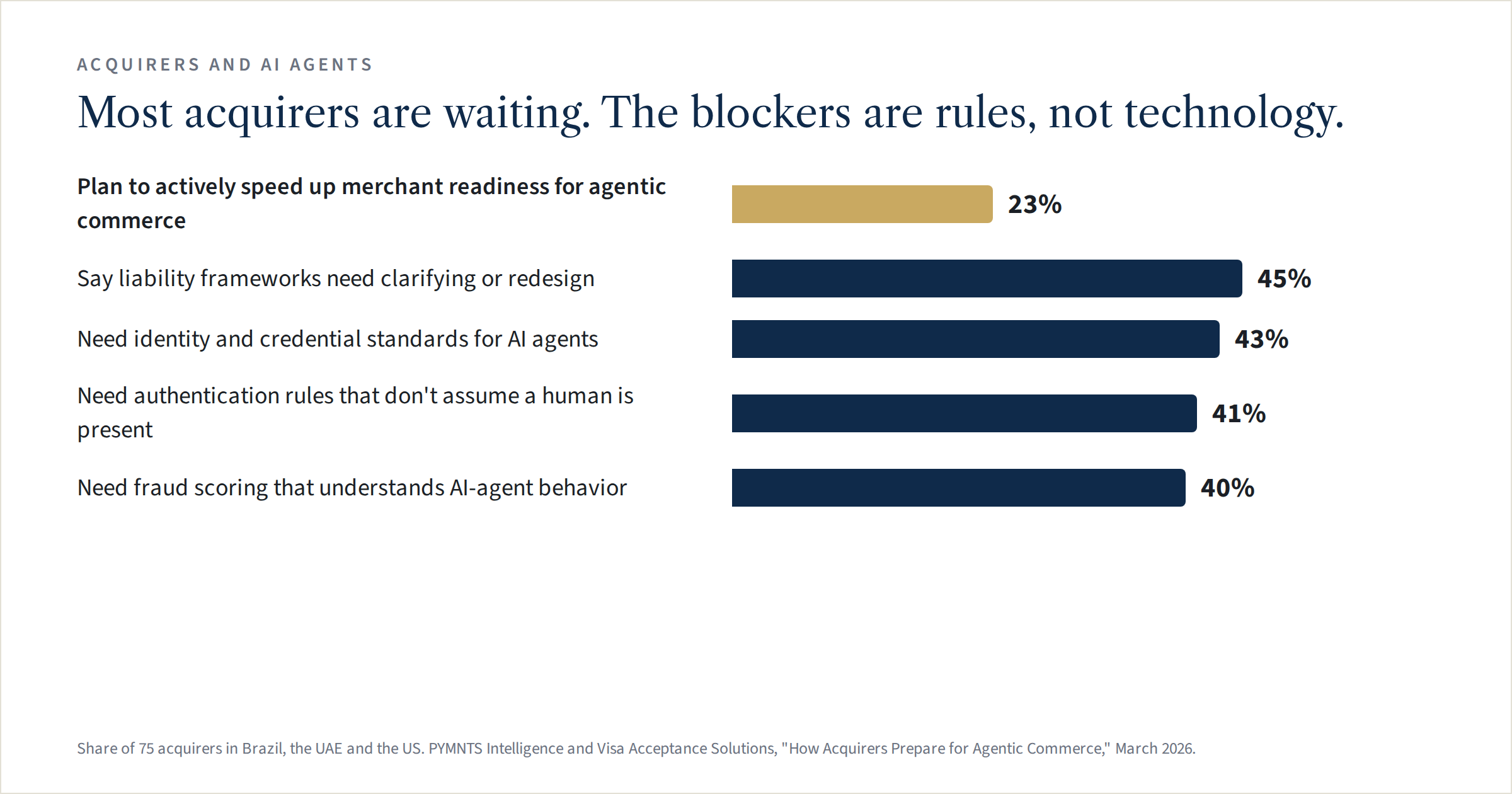
Most acquirers are waiting. In a PYMNTS Intelligence survey with Visa Acceptance Solutions, only 23% plan to actively speed up merchant readiness. The rest are waiting for customers, merchants or big platforms to go first. And what they say needs to change is mostly rules: liability, agent identity, authentication that assumes a human is there.
For a bank choosing a model, that matters. The further right you go, the more of these questions are yours to answer.
It changes how fast you can get there. The long poles in moving right are underwriting, onboarding, risk monitoring and the software behind them. Those are exactly the jobs AI is getting good at, when it's run inside real controls. The two-year build that made "own it" unrealistic for a mid-size bank is getting shorter.
And the software platforms on the other side of the deal need payments more than ever. With AI agents putting pressure on traditional software, PYMNTS has reported that embedded payments are becoming a lifeline for SaaS, and that 90% of small businesses call embedded finance tools in their management software essential. Platforms that want payments are going to be looking for bank partners who can grow with them.
Where to start
If I were advising a bank starting this today, I'd ask three questions before choosing a column:
- Which merchants or platforms do you actually want as customers in three years?
- Which of the core capabilities can you provide today, and which would you build, buy or partner for?
- How much risk is your board willing to carry on its own books, and when?
The answers usually point to a starting model one or two steps to the left of where the ambition is, with a plan to move right. That's not a smaller strategy. It's the one that gets to market while the window is open.
This is the work we do at LPG with banks and the software platforms they serve.
Sources: Visa, Intelligent Commerce Connect (April 2026); PYMNTS, "AI Agents Bring Shoppers, but Merchants Must Close the Sale" (October 2026); PYMNTS Intelligence and Visa Acceptance Solutions, "How Acquirers Prepare for Agentic Commerce" (March 2026); PYMNTS, "Embedded Payments Give SaaS a Lifeline as AI Reshapes Workflows" (February 2026). Revenue ranges are indicative, from Lean Product Group analysis.