Your team stopped complaining. That might be bad news.
A quiet team can mean the problem got fixed. More often it means they've stopped raising it because nothing happened the last five times. Servant leadership has a simple answer for whose job that is.
Picture a team that's been complaining about the same broken process for six months. It comes up in every retro. Their manager nods, writes it down, and says she'll raise it when the timing is right.
Then one month, nobody mentions it.
The room feels calmer. The retro runs shorter. It's tempting to read that as progress. It usually isn't. The process is still broken. What changed is that the team stopped believing anyone would fix it.
Quiet isn't the same as fixed
That broken process isn't abstract. It costs hours every week, it creates rework, and it's probably behind a couple of the missed deadlines that got written up as "execution problems."
The manager knows all of this. What keeps her from acting is that fixing it means an uncomfortable conversation with her own boss, and there's always a reason to have that conversation next month.
Her team noticed. People stop raising a problem once raising it stops doing anything.
Flip the pyramid
James Hunter has a picture for this that sticks. Draw the usual org chart: leader on top, managers in the middle, the team at the bottom. Now turn it upside down.
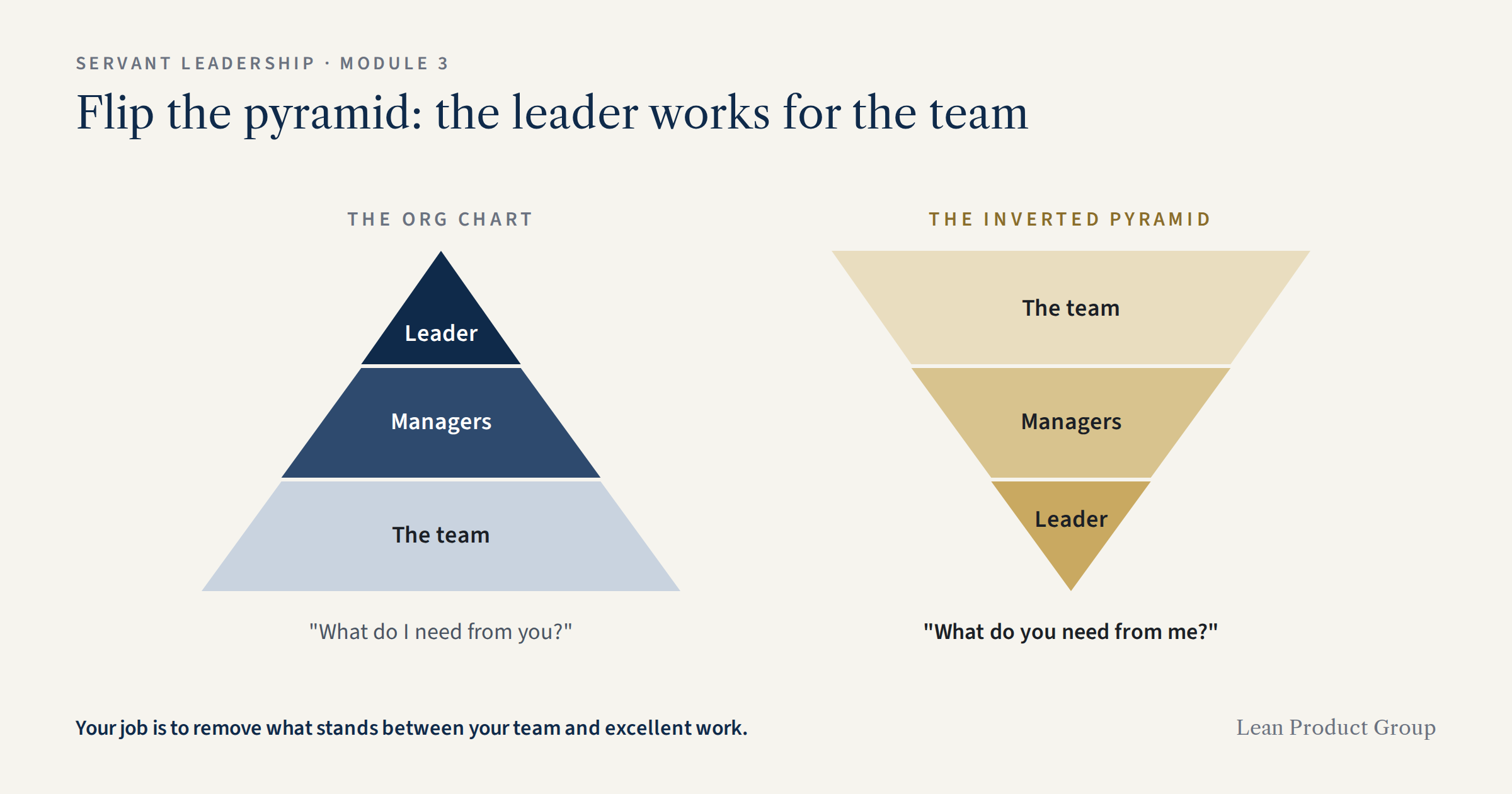
In the inverted version, the team is on top and the leader holds everything up from underneath. The question that runs the relationship changes from "what do I need from you?" to "what do you need from me?"
It isn't a reorg. Nobody's title moves. It's a choice you make in each conversation about who's working for whom.
Needs, not wants
This is where people get servant leadership wrong. It doesn't mean giving your team whatever they ask for.
Hunter is specific: a leader meets legitimate needs, the things that let someone do excellent work. Clarity about what matters. The tools and access to do the job. Honest feedback. Someone clearing the path. That's a different list from keeping everyone comfortable, and a team that never gets pushed doesn't grow much.
The obstacle is yours
Jocko Willink puts the hard version of this plainly: there are no bad teams, only bad leaders. If your team can't do its best work, that's your problem to solve, not theirs.
I'd add one line to that. "I escalated it and nothing happened" isn't solving it. It's a record of having tried. The better question is what you haven't tried yet.
Start with one question
Here's one thing to try this week. In your next 1:1s, skip the status update and ask one question: "What's getting in your way?"
Then listen without defending anything. And whatever you decide to do with what you hear, go back and tell them. Removed it, escalated it, or decided not to act and here's why. The team doesn't need you to fix everything. They need to know you heard them and made a choice.
The rest of the module
This is the third module of The Servant Leader, our leadership curriculum at Lean Product Group. The full module includes a monthly check-in for working as your team's support system instead of its evaluator, a structured way to sort what you hear into what you'll fix, escalate or consciously set aside, and an exercise to remove one real obstacle and track what changes.
The course is free. Sign in with your email and it's yours.