Power gets you compliance. Authority gets you a team.
A title gives you the power to get things done. It doesn't make anyone want to follow you. Most managers run on the first and wonder why their team does exactly what's asked and nothing more.
Here's a test worth running on yourself. What happens on your team when you leave the room?
If the energy picks up, the conversations loosen and people start working the problem, you've learned something. If the work slows down until you're back, you've learned something too. It just isn't as pleasant.
The manager whose team does exactly what he asks
Picture a manager three years into the job. His team delivers. Deadlines get met, the reports come in, nobody misses a meeting. But people do exactly what he asks and nothing more. He schedules check-ins because he's learned that things slip the moment he steps back.
He tells himself the team needs a firmer hand. The more honest explanation is harder to hear: he's been running on his position. The title, the performance reviews, the pressure of the deadline. Those are real tools, and they work. They just produce a very specific result.
Power and authority aren't the same thing
James Hunter draws the line clearly in The Servant. Power is the ability to make people do what you want because of your position. Authority is getting people to do it willingly, because of who you are.
The organization gives you power. It comes with the job. Authority is given to you by the people you lead, and they decide every day whether to keep giving it.
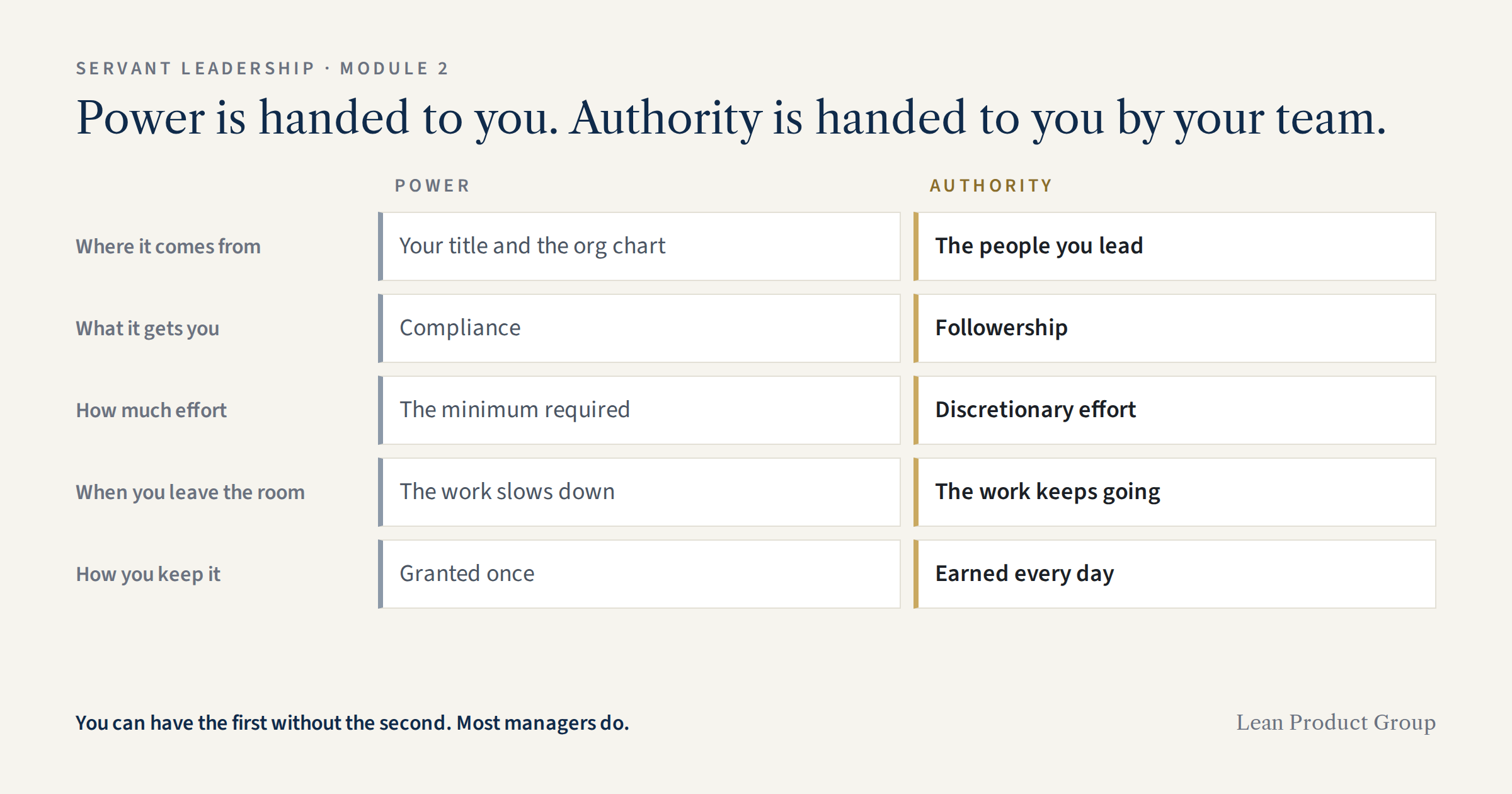
You can have plenty of power and almost no authority. Every team also has someone with no title at all whom everyone listens to. That person has authority without power, and it's worth asking why.
Compliance is the floor
People comply because they have to. They follow because they've decided you're worth following.
Compliance gets the box checked. Followership gets you the things you can't put in a job description: the person who flags a problem before it's on fire, who fixes the thing nobody assigned, who tells you the plan won't work while there's still time to change it.
You can't mandate any of that. It's discretionary, which means it's earned.
You're building it or spending it
The uncomfortable part is that authority isn't something you established once, back when you got the promotion. Noel Tichy describes it as renewed or worn down in every interaction. Following through builds it. Giving credit builds it. Absorbing pressure instead of passing it down builds it. Every dodge, every inconsistency, every moment of protecting yourself spends a little.
There's no neutral conversation. You're always doing one or the other.
One place to start
David Marquet changed one habit on his submarine that's worth stealing. He stopped his officers from asking permission. Instead of "I'd like to," they said "I intend to," and he only stepped in if something was wrong. Authority moved to the people who actually had the information.
You can try a version of that this week. Take a real problem you haven't solved yet to someone on your team who's reliable but flat, and ask what they'd do. Then listen all the way through before you say anything. If their answer is good, use it, and tell them you're using it.
Watch what happens to the energy in the room.
The rest of the module
This is the second module of The Servant Leader, our leadership curriculum at Lean Product Group. The full module goes further: mapping where each relationship on your team sits between compliance and followership, rebuilding a moment where you used your position instead of your influence, and a guided conversation to run with one person.
The course is free. Sign in with your email and it's yours.