The leadership decision most managers never make
Most of us became managers because we were good at the work. Nobody asked what kind of leader we intended to be, and the calendar filled up before we asked ourselves. That skipped decision is where a lot of management problems start.
Most people become managers the same way. You were good at the work, someone noticed, and one Monday you had a team.
Nobody sat you down and asked what kind of leader you intended to be. There was a new tool to learn, a budget to own, a backlog of 1:1s to schedule. The question never came up, and after a few months it felt too late to ask.
I think a lot of management problems start right there. Not with bad intent. With a decision that never got made.
The reflex in the 1:1
Picture an ordinary 1:1. Someone on your team tells you something is broken. A handoff keeps failing, a peer keeps dropping work on them, or a process nobody owns is eating their week.
You know the reflex. Agree that it's frustrating. Say you'll raise it with your own boss. Blame the process a little. Move to the next item.
It's efficient. It even feels supportive. And nothing changes, because the reflex was never a decision. It was a habit you picked up somewhere and kept.
The useful moment is the one where you notice you're doing it. That's the moment you stop managing on autopilot and start choosing.
A title doesn't make you a leader
James Hunter makes this point in The Servant, and I come back to it often. A title gives you authority over outcomes. It doesn't give you the ability to lead people. That comes from character, and character gets built one choice at a time, mostly the inconvenient ones.
Peter Drucker got there from a different direction. In "Managing Oneself" he argued that you can't manage anyone well until you know your own strengths, values and habits. Most of us skip that work because nobody asks us to do it. There's no review cycle for it.
The gap you can measure
Ask any manager for their values and you'll get a good list. Respect. Candor. Accountability. Developing people. I've never heard anyone say "I value avoiding hard conversations."
Then look at the last 30 days. Where did your time actually go? Which conversations did you push to next week? Who got your patience, and who got your shortest answers?
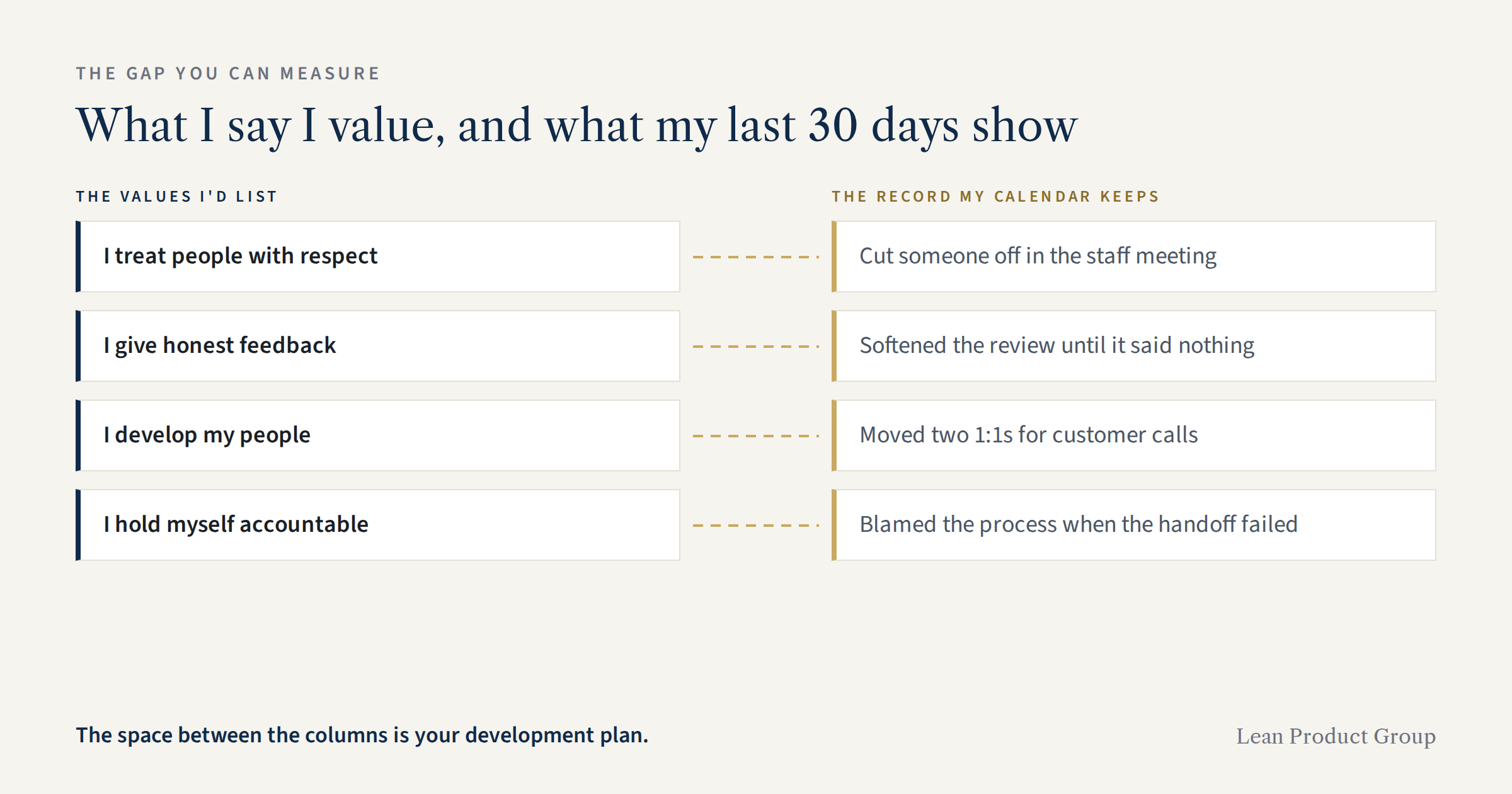
The space between the list you'd write and the record your calendar keeps isn't a character flaw. It's the most honest development plan you'll ever get. The catch is that you have to measure it, and most leaders never do.
You're part of the system
Deming taught that most problems in an organization are system problems, not people problems. Leaders love that idea when it's about their team.
It gets less comfortable when you remember you're part of the system too. If trust never builds on your team, if the same conversation breaks down in the same place every time, you aren't watching that from the outside. You're one of the inputs.
Where to start this week
You don't need an offsite. You need about an hour and some honesty.
- Write down three things you believe about how people should be treated at work. Make them sentences someone could hold you to. Not "I value respect," but "I don't criticize people in front of their peers."
- For each one, find a moment in the last month when you lived it and one when you didn't. Name the meeting.
- Pick the gap that would change the most for your team if you closed it. Choose one behavior you'll do differently starting Monday.
Keep it somewhere you'll see it. It's harder to ignore once it's on paper.
Why we start here
This is the ground the first module of The Servant Leader, our leadership curriculum at Lean Product Group, stands on. The course goes a lot further: a written leadership credo, a structured gap analysis with worksheets, and nine more modules on authority, trust, giving control, hard conversations and managing up.
It starts here on purpose. Every other leadership skill sits on top of this decision.
If you lead people, make it on purpose. Your team is already living with the one you've been making by default.
Members can work through the full module in The Servant Leader.