Your calendar is full of quick questions. You trained your team to ask them.
When every decision runs through you, it feels like being thorough. It's actually a habit you're teaching your team one answered question at a time. Here's how to see it, and how to start giving control back without creating chaos.
Picture a manager whose team is genuinely good. Smart people, solid work. And every decision runs through her anyway.
Big calls, small calls, it doesn't matter. Her calendar fills up with "got a sec?" and "quick question." She knows she's a bottleneck. She tells herself she's just being thorough.
Then she notices something worse than the calendar. Her team has stopped bringing her problems with a recommendation attached. They bring the problem and wait. Ask them for a recommendation and she gets a list of options, which is really a polite way of asking her to choose. When she's out for a day, decisions just sit.
None of this happened by accident. She trained it, one helpful answer at a time.
Every answer is a lesson
That's the uncomfortable part of what David Marquet found as a submarine captain, and wrote about in Turn the Ship Around. When a leader answers every question and makes every call, the team learns exactly one thing: wait for the leader.
It looks like patience. It's really conditioned dependence. And it produces a team that can't function well without its manager in the room, which is the opposite of what leading is supposed to accomplish.
The trap is that each individual answer feels like service. Someone asked, you knew, you helped. It's only when you add them up that you see what you've built.
Change the first few seconds
Marquet's fix was simple enough to sound trivial. His officers stopped asking permission ("I'd like to do this, may I?") and started stating intent ("I intend to do this"). He stepped in only if something was wrong.
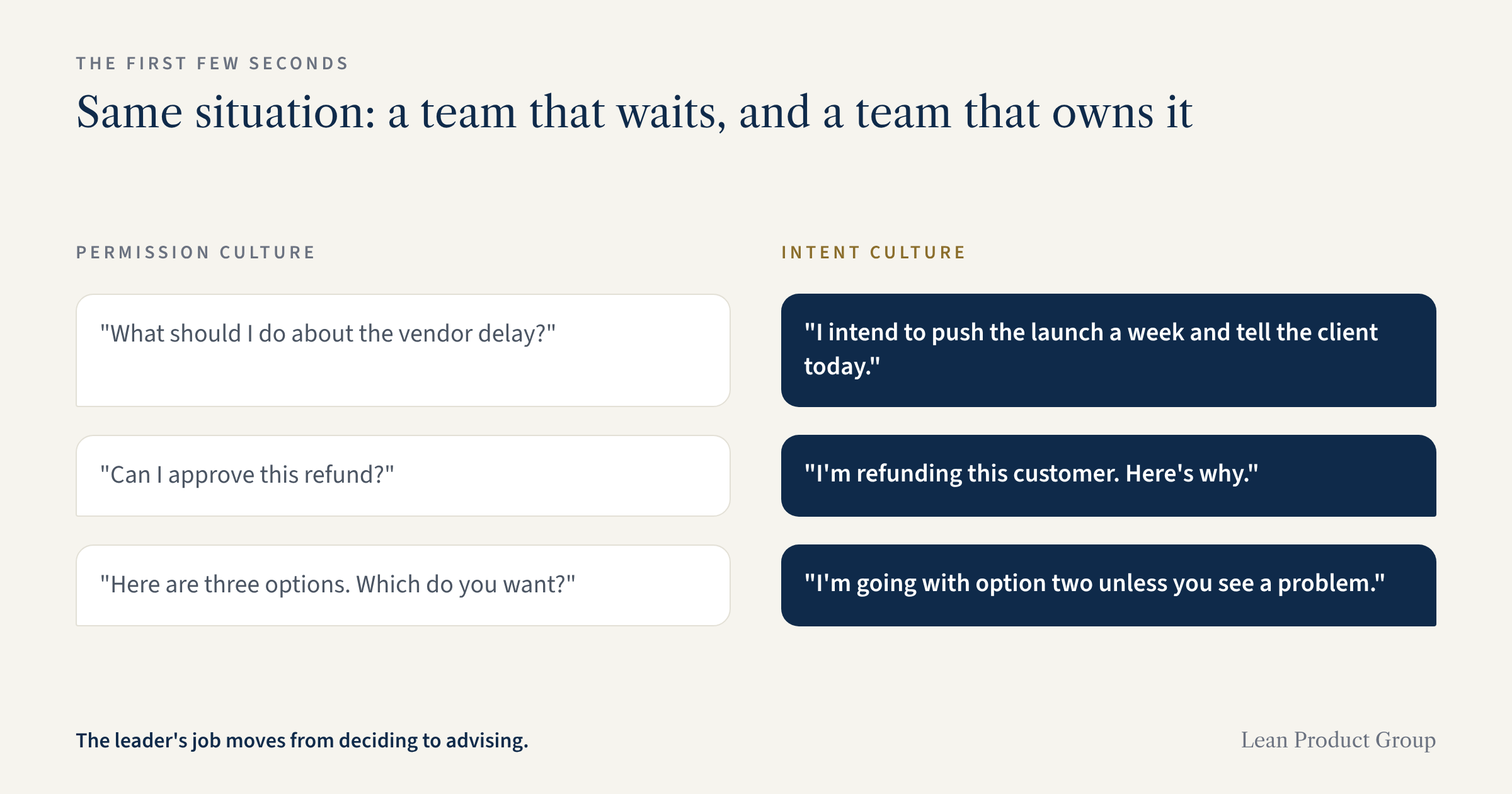
The change happens in the first few seconds of a conversation, and it changes who has to think. To say "I intend to," you need a point of view before you walk in. The leader's job shifts from deciding to advising.
What you say in those first few seconds matters too. When someone brings you a decision that isn't really yours to make, the most useful response is often a question: "What do you intend to do?"
You still own the outcome
Giving control isn't the same as walking away. Jocko Willink's point in Extreme Ownership is that owning the result doesn't mean controlling every input. It means building a team that makes good decisions when you're not there, and making sure people have the context to do it.
A good rule: decisions belong with whoever has the best information, not whoever has the biggest title. Usually that's the person closest to the work.
Not everyone is ready for the same amount
Here's where a lot of well-meaning managers go wrong. They read a book about empowerment and hand everyone full autonomy on Monday. The people who were ready love it. The people who weren't feel abandoned.
Shu Ha Ri, a concept from Japanese martial arts, is a useful way to think about this. People move through three stages, and each one needs something different from you.
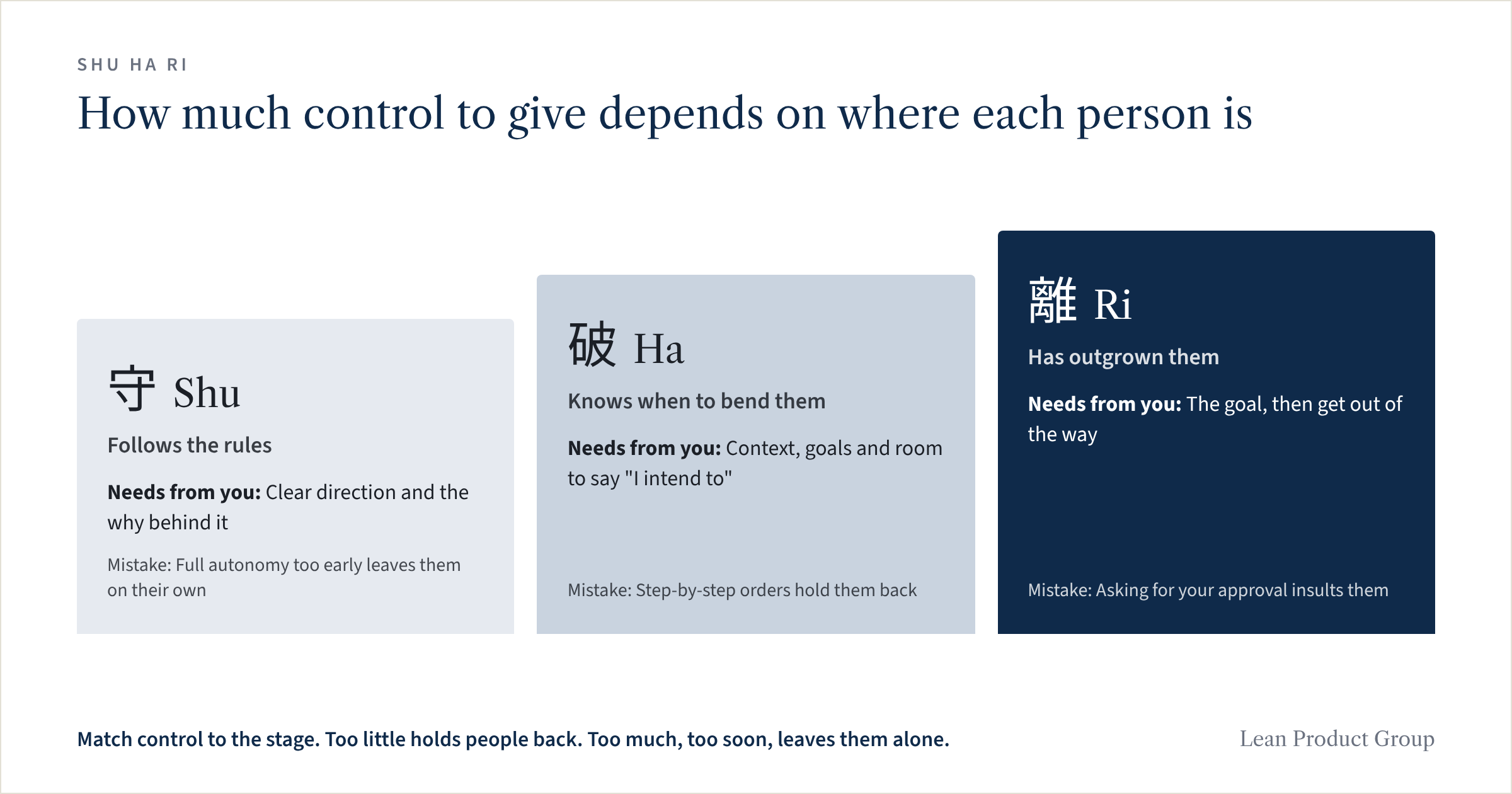
Someone new to the work needs direction, and that's not a failure. Someone who understands the work well enough to know when to bend the rules needs context and room to state their intent. Someone who has mastered it needs the goal and then for you to step aside. Requiring that person to get your sign-off on everything isn't careful. It's insulting.
The skill is knowing who is where, and adjusting.
Try this before your next meeting
Next time you'd normally walk into a meeting with the answer, walk in with the problem instead. State the goal and the real constraints, then ask the room what they think you should do.
Then the hard part: listen to everyone before you say anything. Don't steer. If the team's answer is sound, go with it, and say out loud whose reasoning changed your mind.
The rest of the module
This is the fifth module of The Servant Leader, our leadership curriculum at Lean Product Group. The full module includes rewriting your own directives as intent statements, a delegation experiment with a real decision you'd normally keep, a full walkthrough for running that first problem-not-solution meeting, and a coaching prompt for figuring out what's actually stopping you from letting go.
The course is free. Sign in with your email and it's yours.