AI looks brilliant until you know the subject
The less you know about a subject, the better AI looks at it. Experts looking at the same output see average work with real problems in it. That gap explains a lot of AI hype, and it tells you exactly who should be reviewing what AI produces.
A post from Las Sabir, who runs a company called PowerMatch, crossed my feed this week and I haven't stopped thinking about it. His point, roughly: when you don't know a topic well, AI looks extremely good at it. When you know the topic well, you can see how average the work is. He closed with a line I'd underline: "Most AI hype is just non-experts being easily impressed."
I shared it and said it rings more true every time I read it. Here's why I think he's right, and where I'd take it one step further.
Same output, two readers
Say you ask AI to build a refund feature for a payments system. Four minutes later you have working code.
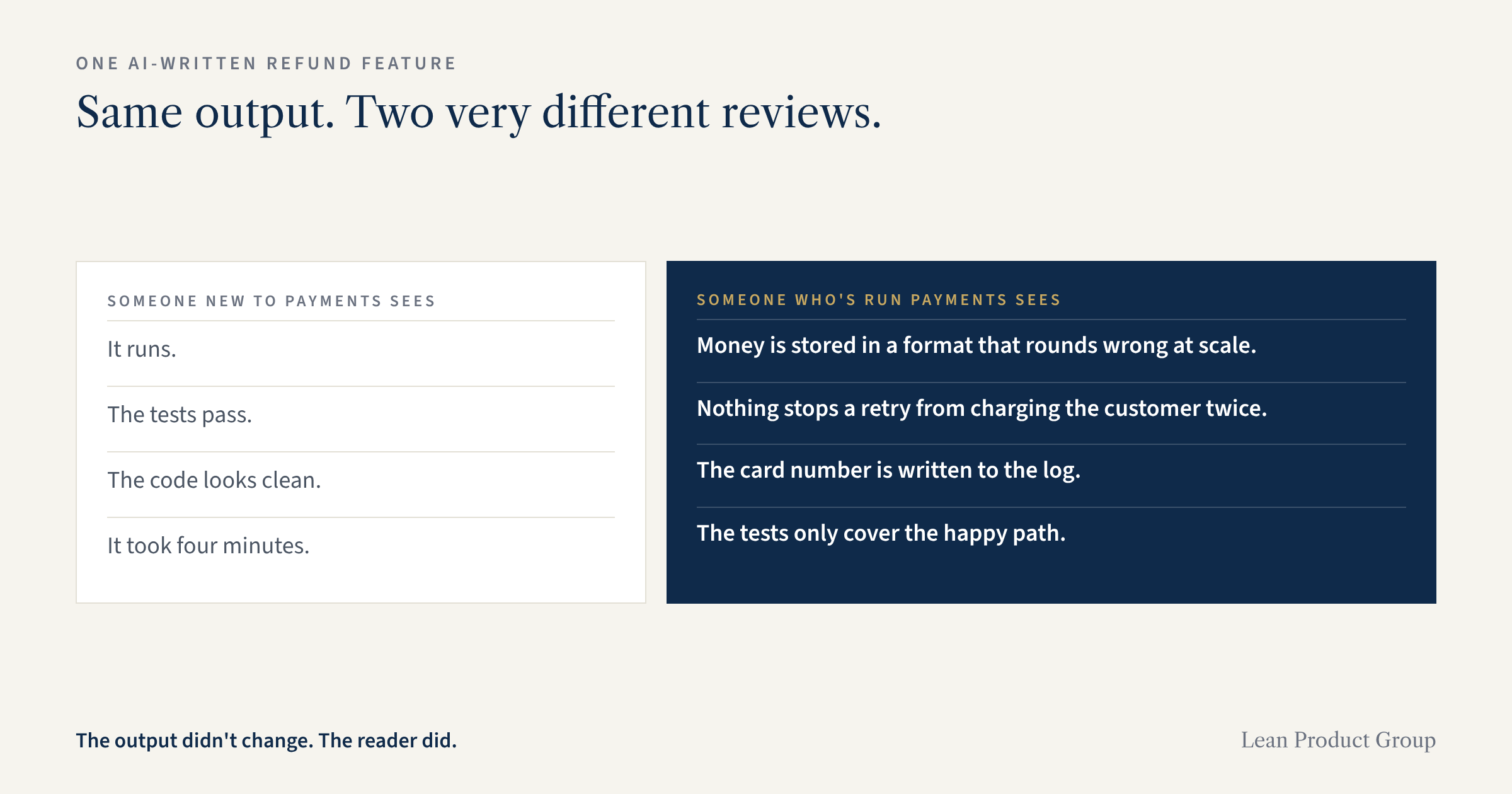
Someone new to payments is thrilled. It runs. The tests pass. It would've taken them a week.
Someone who's run payments for years reads the same code and winces. The amounts are stored in a format that drifts by fractions of a cent, which is nothing until you settle a few million transactions. There's nothing to stop a network retry from refunding the customer twice. A card number is being written to a log file. And the tests pass because they only test the case where everything goes right.
The output didn't change. The reader did.
You've seen this before
Michael Crichton had a name for something close to this. He called it the Gell-Mann Amnesia effect, after the physicist Murray Gell-Mann. You open the newspaper to a story about your own field and it's full of mistakes. Then you turn the page and believe everything you read about a field you don't know.
AI works on us the same way. In the subject I know best, I can see the gaps in what it gives me. In a subject I don't know, the same quality of answer looks like genius, because I don't have what I'd need to see the gaps.
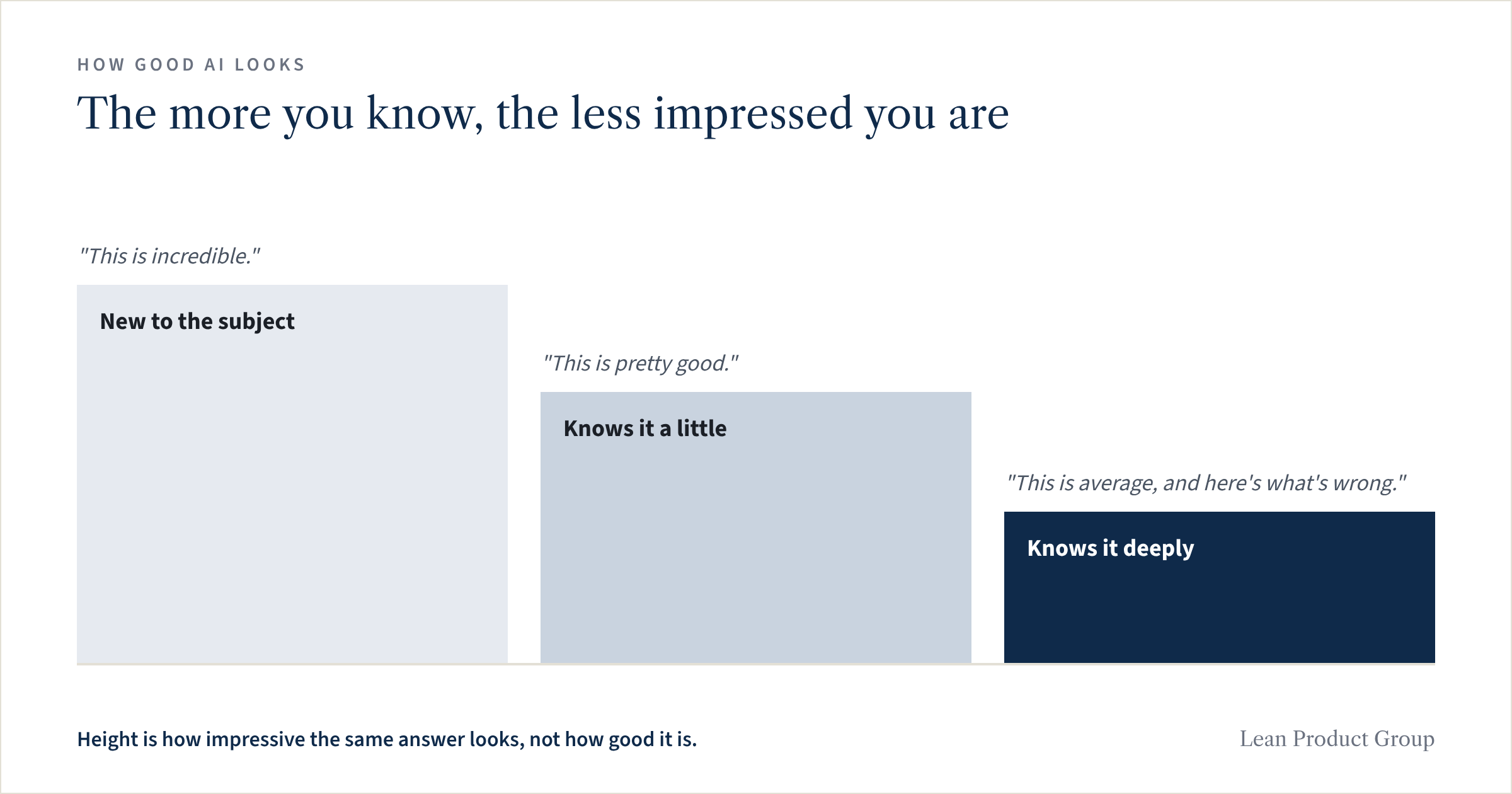
That's the uncomfortable part. AI is the most convincing exactly where you're least able to check it.
The demo problem
This is why AI demos land so well in boardrooms. A leader watches AI produce a legal summary, a marketing plan or a block of code in a field that isn't theirs, and it looks finished. The people who'd know better usually aren't in the room.
I'm not saying leaders shouldn't be excited. I am. But before you act on being impressed, ask the person on your team who knows that subject cold what they see. Their answer is the real demo.
Where I'd go one step further
Las draws a line. Use AI to work faster, and don't hand it strategy or anything high-level. I think that's a sound place to start.
Here's what I'd add. Average is where AI starts. It doesn't have to be where it stops. The same expert who can see what's wrong with the output is the one person who can tell AI how to do it right, and can write that down so it's done right the next time too.
That changes what the expert is worth. A beginner with AI produces average work faster, and can't tell that it's average. An expert with AI produces expert work faster, because they catch what's wrong and correct it. I wrote more about how to capture that in AI is your newest junior engineer. Onboard it like one.
So the hype and the value come from opposite ends. The hype comes from people who can't judge the work. The value comes from people who can.
Three rules for teams
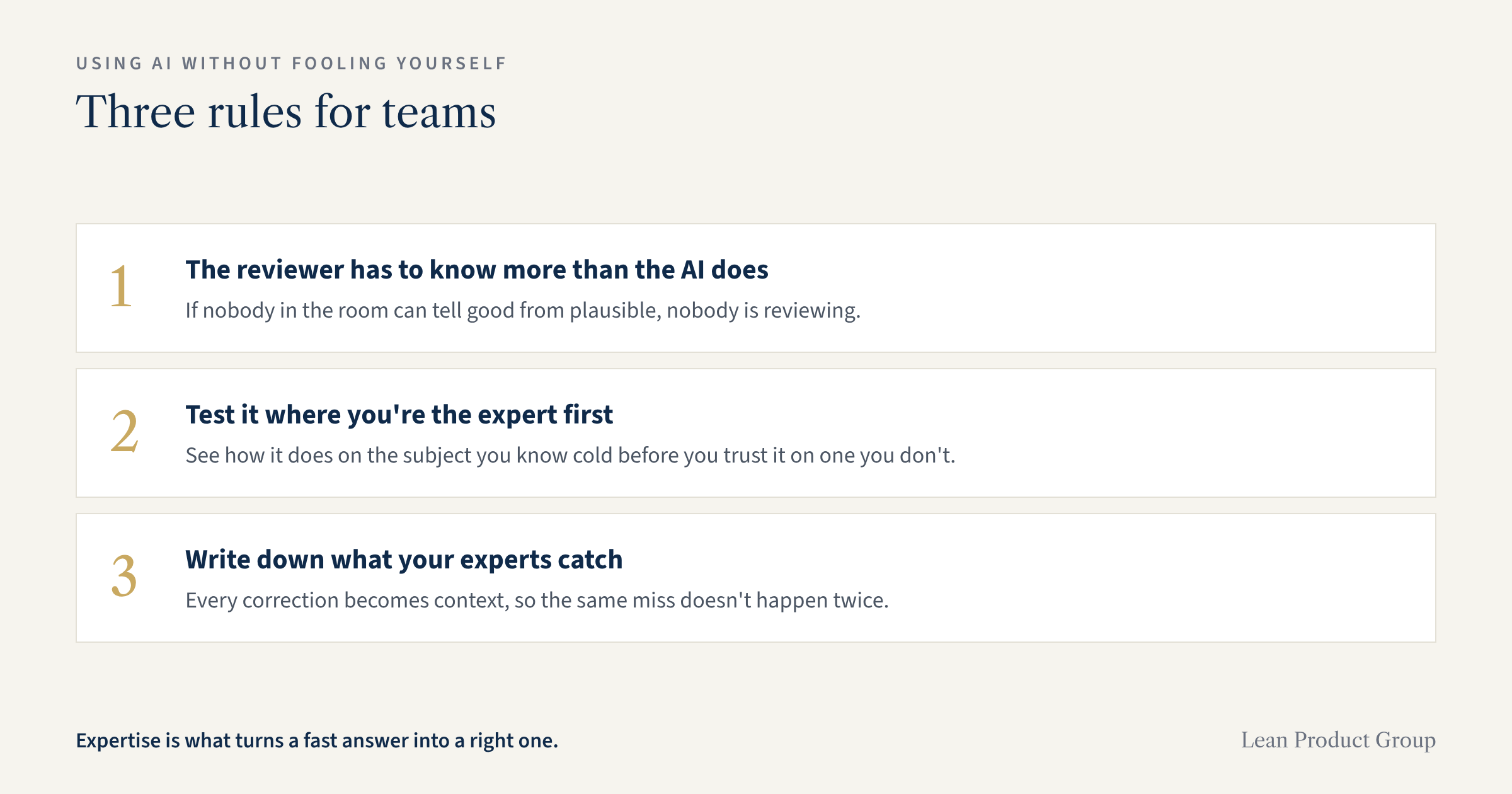
The reviewer has to know more than the AI does. A review by someone who can't tell good from plausible is a rubber stamp. Put your most experienced people on the output that matters most.
Test it where you're the expert first. Before you trust AI in an area you don't know, watch how it does in the one you know best. Whatever it gets wrong there, assume it's getting something similar wrong everywhere else.
Write down what your experts catch. Every time an expert corrects AI, that's knowledge. If it stays in their head, they'll make the same correction next week. If it gets written into the context AI works from, the mistake stops happening.
What this means for hiring
Some people read the hype and conclude that expertise matters less now. I've come to the opposite view. When anyone can produce something that looks right in four minutes, the scarce skill is knowing whether it is right.
That's the work we do with teams at LPG: putting the people who can tell the difference in charge of what AI builds.